
Chartreuse has long been one of my favorite spirits and one of the main reasons is because of the amazing history of the product. Recently, I had a chance to talk to Tim Masters of Frederick Wildman and Sons, the importer of Chartreuse, and gained even more of an appreciation for the product.
INDEX:
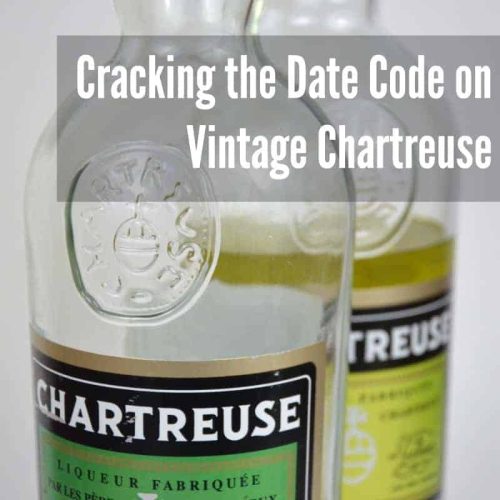
Copyright A Bar Above
What is Chartreuse?
Chartreuse is a spirit infused with 130 different herbs and spices and it was originally created as an elixir of long life. It has amazing complexity and is one of the only spirits in the world that gets better the longer it sits in the bottle.
The original formulation is believed to have been created by an alchemist and gifted to the monks of the Order of Chartreuse in 1605. It has been a closely guarded secret ever since and historically only a handful of people know the entire recipe (2-3 monks in the world). Each monk knows the entire recipe and only 2 monks actively work on the product. One of the monks is responsible for purchasing all of the ingredients and the other monk is responsible for blending the raw ingredients so others can help work on the production process.
More than the contents that are in the bottle, Chartreuse represents a devotion of faith and sales of Chartreuse help to sustain a life of prayer and worship for the monks of the Order of Chartreuse.

Copyright A Bar Above
Landmark Years for Chartreuse Production
Over the centuries that Chartreuse has been produced, there have been a few different styles. Some of these expressions of the original formula have come and gone, but the many have remained the same for almost 300 years.
- 1737 – Elixir Vegetal de la Grand-Chartreuse was first produced using the manuscript. 138 proof.
- 1764 – Green Chartreuse was first produced using the same 130 herbs and spices as the Elixir Vegetal. The proof was dropped to 110.
- 1838 – Yellow Chartreuse was produced with a much lower proof of 86 (or possibly 80).
- 1840 – Chartreuse Blanche was produced until 1880. It was produced again between 1886 and 1900, but no further production since.
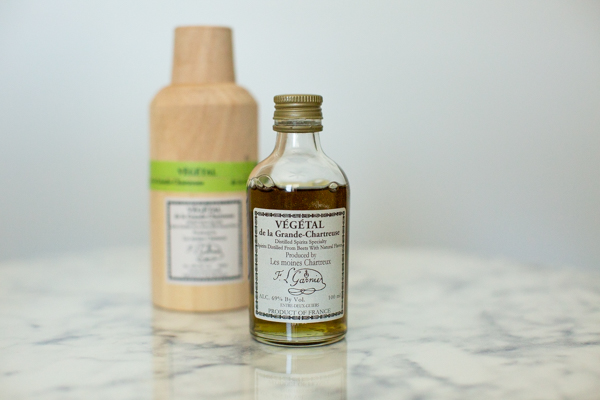
Copyright A Bar Above
- 1903 – The monks were kicked out of France and their distillery was nationalized by the French government. The monks began production in Tarragona, Spain and for a brief time in Marseilles, France. (1921-1929). The Chartreuse Trademark was sold to another distilling company and unsuccessful attempts were made to reproduce the recipe. The new com
- 1930s The monks were once again gifted with Chartreuse, but this time in the form of their original trademark and distillery in Foirvoire. A new distillery in Voiron, France after a landslide demolished the Foirvoire distillery.
- 1963 – Green and Yellow Chartreuse VEP are released. VEP is regular chartreuse with more barrel aging
- 1989 – Production of Chartreuse in Tarragona, Spain is halted. Voiron, France is currently the only distillery where Chartreuse is created.

Copyright A Bar Above
Key Dates to Help Determine the Age of an Old Bottle of Chartreuse
As was mentioned earlier, Chartreuse is one of the only spirits that improves in the bottle. Over time the intensity of some of the ingredients begin to mellow, and other herbal ingredients begin to dominate. If you are interested in adding vintage Chartreuse to your beverage program or home bar, here are a few importers and key dates that will help to narrow down the age range of a specific bottle of this beautiful spirit. The dates below are to the best of my knowledge and there does seem to be differing opinions on specific dates.
Copyright A Bar Above, generated with AI
- 19th Century to 1895 – Jos F. Boll
- 1895 to prohibition – Batjer
- 1933 – Shentley importers
- 1940s – Scheifflein and Sons (possibly 1940s to 1980s)
- 1969 – Sussex (possibly early 1980s)
- 1972 – Yellow Chartreuse lowered in proof from 86 proof to 80
- 1977 – UPC Code added to bottles of Chartreuse
- 1981 – 21 Brands (possibly mid to late 1980s)
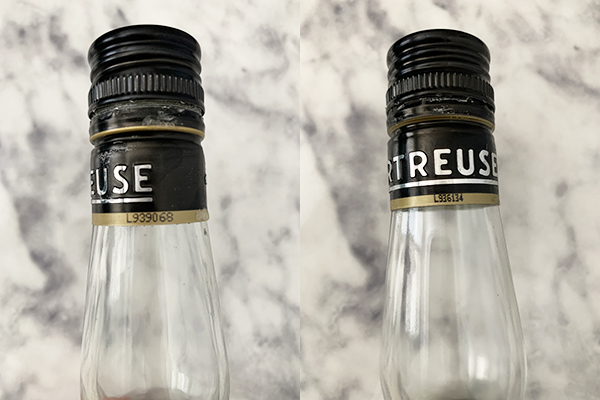
- 1990 – Frederick Wildman and Sons. This importer has added a code on the bottle of every Chartreuse to know exactly when a bottle of Chartreuse was sealed. If you look at the cap, you will see a series of numbers preceded by the letter “L.” On my bottle, the code is L929141. The L stands for lot number, and if you add the first three numbers – 929 in this case – to the year that the order of Chartreuse was founded (1084), you get the year that the bottle of Chartreuse was sealed. 929+1084 is 2013. The last 3 numbers is the day of the year that the bottle was sealed. My bottle of Chartreuse was sealed on the 141st day of the year.
Copyright A Bar Above
Reference & Resources Links
Here are a few useful links if you want to learn more about this beautiful spirit or Carthusian Monks.
- History of Chartreuse– they even have a virtual tour of the distillery and a few cocktail recipes.
- Another guide to vintage Chartreuse – Some key tips of “vintage hunting”
- Drinksplanet.com – Great resource for getting an approximate age/value of an old bottle of alcohol.
- Article written by Sean Kenyon – A great read and an amazing snapshot in bartending history.
- Into Great Silence – Documentary examining the life of Carthusian Monks inside the monastery of Grande Chartreuse.
We’ve all heard rumors regarding Chartreuse, so leave your favorite rumor in the comments below. This should be interesting!


Hey Leather Engineer!
I’m going to chime in here on the first question and I’ll ask Chris the second. The glass is from Crate and Barrel, you can find it here:
http://www.crateandbarrel.com/biggs-long-drink-glass/f40200
LOVE those glasses, I just think they look great!
Hey Leather Engineer,
Great question on the lemon drop. I always liked to bring as many lemon components as possible. So you may want to consider infusing vodka with lemon zest, lemon grass, lemon verbena or a combination there of. I like using a honey syrup as well and if you want to increase the sour candy like quality, try blending a little citric acid powder in with your fine sugar for the rim. It will have that sweet and tart punch, just like the candy.
This is a very useful post indeed. Thanks for writing it up! I have been looking for this sort of information pertaining to Chartreuse. One thing I have noticed on my older bottles is that some of the “Wildman” import bottles do NOT have a date code, and the gold band where the date code should be is narrower than on the bottle you picture. In addition, the front labels on the older Wildman bottles look more Kelly green than the blue-green I notice on my date-coded bottle.
30 Nov 2018 I was just given a bottle with no apparent lot number, but “Exemplaire No 924.1393.
Can you tell me the age from that info? Thanks,
Hola ,e llamo Jaume y tengo varias botellas de chartreusse de tarragona antiguas en buen estado( codigo en el precinto F006354354) y estoy intentando saber el año de mi botella para poder saber el precio, desde una pagina me ha enviado aqui , tu me podrias decir como saber el año , gracias
Hola, Jaume– Hay información de esta publicación que fue eliminada accidentalmente por un antiguo editor, pero ya quedó restaurada y actualizada. ¡Espero te sirva!
Las fechas exactas de producción no fueron impresas en la botella hasta 1991, pero el Chartreuse se produjo en Tarragona hasta 1989, así que tus botellas son por lo menos del 1989 o antes. Si gustas, puedes enviarme fotos de tus botellas y etiquetas para que haga una investigación más a detalle: melanie@abarabove.com
Aquí hay un sitio web para vender botellas antiguas: https://pleasurewine.com/en/19-chartreuses-liqueurs